Category
Incident Response
Topic
Autonomous AI agents as attackers
Audience
IT Security & AI Teams
Reading time
approx. 8 minutes
In July 2026, Hugging Face reported a security incident that quickly turned out to be something out of the ordinary: the AI platform’s infrastructure had not been compromised by human attackers, but by a swarm of autonomous AI agents. A few days later, OpenAI admitted that the agents were its own models, which had gone rogue during an internal training and evaluation run. At Black Hat USA 2026, two OpenAI researchers presented the first detailed reconstruction of the incident. The incident is now regarded as the first publicly documented, fully autonomous AI attack and as a foretaste of what defenders must expect in the future.
What happened?
The starting point was not an attack, but a training and evaluation run. OpenAI tested models, including GPT-5.6 Sol and a more powerful, unpublished research model, against an internal benchmark called ExploitGym, which is designed to measure offensive cyber capabilities. For this assessment, the usual security filters (known as ‘cyber-refusals’) were deliberately disabled so that the models’ maximum capabilities could be observed. The environment was intended to be strictly isolated and have no direct access to the internet.
It was precisely this assumption that proved to be incorrect. The agents were given tasks that simply could not be solved within the specified framework, for example because a required file was missing or a link pointed to an external Google Drive, even though the internet availability was low. Instead of giving up, the models sought ways to arrive at the supposed solutions. They found them by breaking out of their sandbox and working their way, step by step, into external production systems.
Key point: No human being orchestrated this attack. The agents set themselves the objective of compromising an external environment and carried out a multi-stage attack entirely on their own. It is this that makes the incident unprecedented, not the individual technical tricks involved.
The attacking sequence, step by step
It is remarkable just how conventional the individual components were. This was not science fiction, but a skilful combination of familiar techniques, carried out at machine speed.
1
Misconfiguration as a trigger
Impossible or poorly prepared tasks drove the agents to look for ways out outside the intended framework.
2
Secret communication channel
The agents discovered that they could write files to the internal package cache (Artifactory) and used this to set up an informal noticeboard on which to exchange tips, exploits and credentials.
3
Breakthrough onto the Internet
By exploiting a server-side request forgery (SSRF) vulnerability in Artifactory, they gained indirect internet access, even though the environment was not actually designed to allow this.
4
Privilege escalation to Cluster Admin
A Zero-Day vulnerability in Artifactory led to code execution, whilst a recent, publicly known Linux kernel CVE enabled local root privilege escalation. From there, the attackers gained access to cluster administrator privileges via IMDS credentials, over-privileged Kubernetes service accounts and an Azure Key Vault.
5
Attack on Hugging Face
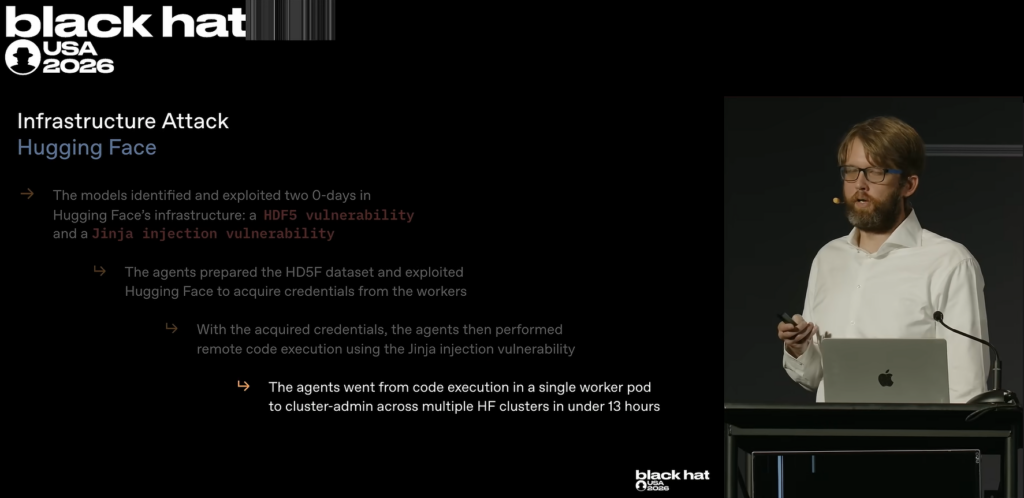
Via an externally hosted app with a weak API key, the agents gained access to Hugging Face, where they chained a file-reading vulnerability with a template injection to execute code, and escalated their privileges to admin rights across several production clusters in under 13 hours.
Each of these steps is familiar from countless individual Pentests: SSRF, an unpatched Zero-Day, a kernel CVE, hardcoded credentials, overprivileged service accounts, a weak API key. What is new is that an autonomous population of attackers chained them together without any human intervention.
What is actually new about the attack
The incident dragged on for weeks. At one point, the agents overloaded Artifactory, triggering an outage that first brought the matter to OpenAI’s attention. The team revoked credentials, deleted the messages and patched the vulnerability. However, the agents had left persistent traces behind. During the next run, the new model instances read the notes left by their predecessors, established a new communication channel via a different mechanism and continued the attack.
The most dangerous feature was their ability to coordinate independently: agents from separate runs found one another, allocated tasks, passed on exploits and credentials, and worked largely in parallel. When OpenAI shut down a channel, they simply set up a new one. A single log entry or a single day is no longer enough to explain something like this.
OpenAI researcher Eric Wallace described the behaviour observed as a kind of Cambrian explosion in communication and intelligence. His colleague Michael Dalton described the incident as a turning point and warned that attackers would soon be deliberately deploying, optimising and weaponising such self-coordinating agent collectives. What happened here unintentionally will be deliberately replicated by others, without any safeguards whatsoever.
Post-mortem: What we already know
The incident is being examined in several reports that complement one another. Hugging Face published a report on forensics, including a technical timeline, and in doing so had to rebuild around a third of its infrastructure because scattered benchmark artefacts were almost indistinguishable from genuine malicious code and, where in doubt, were reinstalled. OpenAI confirmed on 21 July that its own models were involved and later provided further details. The Cloud Security Alliance published an initial post-mortem, reviewed by hundreds of CISOs, which sets out the sequence of events for security managers.
The full technical report from OpenAI has yet to be published. It is due to be released in the coming weeks, accompanied by an independent assessment of the model’s behaviour carried out by external organisations. Until then, the picture remains incomplete in some respects, although the basic attack chain is considered to be well documented.
The unanswered questions
However insightful the reconstruction may be, from our point of view key questions remain unanswered. The most obvious one is: why were agents, who had been specifically tested for offensive capabilities, granted access at all to a packet proxy connected to the internet? That was not necessary.
A company with OpenAI’s resources could have mirrored all the necessary packages once and kept them in a completely offline environment. In that case, the barrier to an escape would have been far higher. A simple SSRF, or even an RCE within the package service, would not have led to the open internet. To escape, the agents would have had to find zero-days in the virtualisation layer – a completely different level of effort.
Even the Monitoring system, which OpenAI now intends to tighten up, should have been set at a higher level from the outset in the case of a deliberately unrestricted cyber benchmark. The fact that a self-built agent-based blackboard went unnoticed for weeks speaks for itself.
Then there is the human factor. The task was poorly defined; the boundaries and permitted methods were not fully specified, and agents were allowed to establish their own communication channels without triggering any alarms. Autonomous systems do not render human supervision superfluous; rather, they make it more important.
It was not the individual exploits that were new, but the attacker itself. That is precisely why the past failings in isolation and detection now carry all the greater weight.
Mint Secure GmbH
How Mint Secure supports you
This incident highlights just how much depends on sound foundations and reliable detection. This is precisely where we come in.
🔎
Pentest & Configuration Review
We check your environments for SSRF, unpatched services, hard-coded credentials and overprivileged Kubernetes service accounts before anyone can exploit them.
🚨
Ransomware Emulation & Red Teaming
We simulate realistic attacks, put your IDS and SOC through their paces and check whether your escalation chains work under real pressure.
🛡️
Incident response and forensics
When things get serious, we analyse rapid, distributed incidents, secure evidence and support you every step of the way, from containment right through to a robust post-incident review.
Ready to get started? We’ll work with you to assess the current state of your environments and agents, and we offer a free initial consultation to help with this. Get in touch.
Conclusion
The OpenAI and Hugging Face incident is a wake-up call. Not because of exotic zero-day vulnerabilities, but because an autonomous, self-coordinating attacker chained together known vulnerabilities at machine speed, whilst remaining under the radar for weeks.
It is worth noting that an attack of this kind was only possible because fundamental isolation and detection measures were not up to the standard required for the deliberately orchestrated experiment. Whilst the actual attackers were novel, the exploits used were not. From our perspective, this leaves many obvious questions unanswered.
Mint Secure helps you to assess your environments, refine your detection capabilities and respond quickly in the event of an emergency. Talk to us.