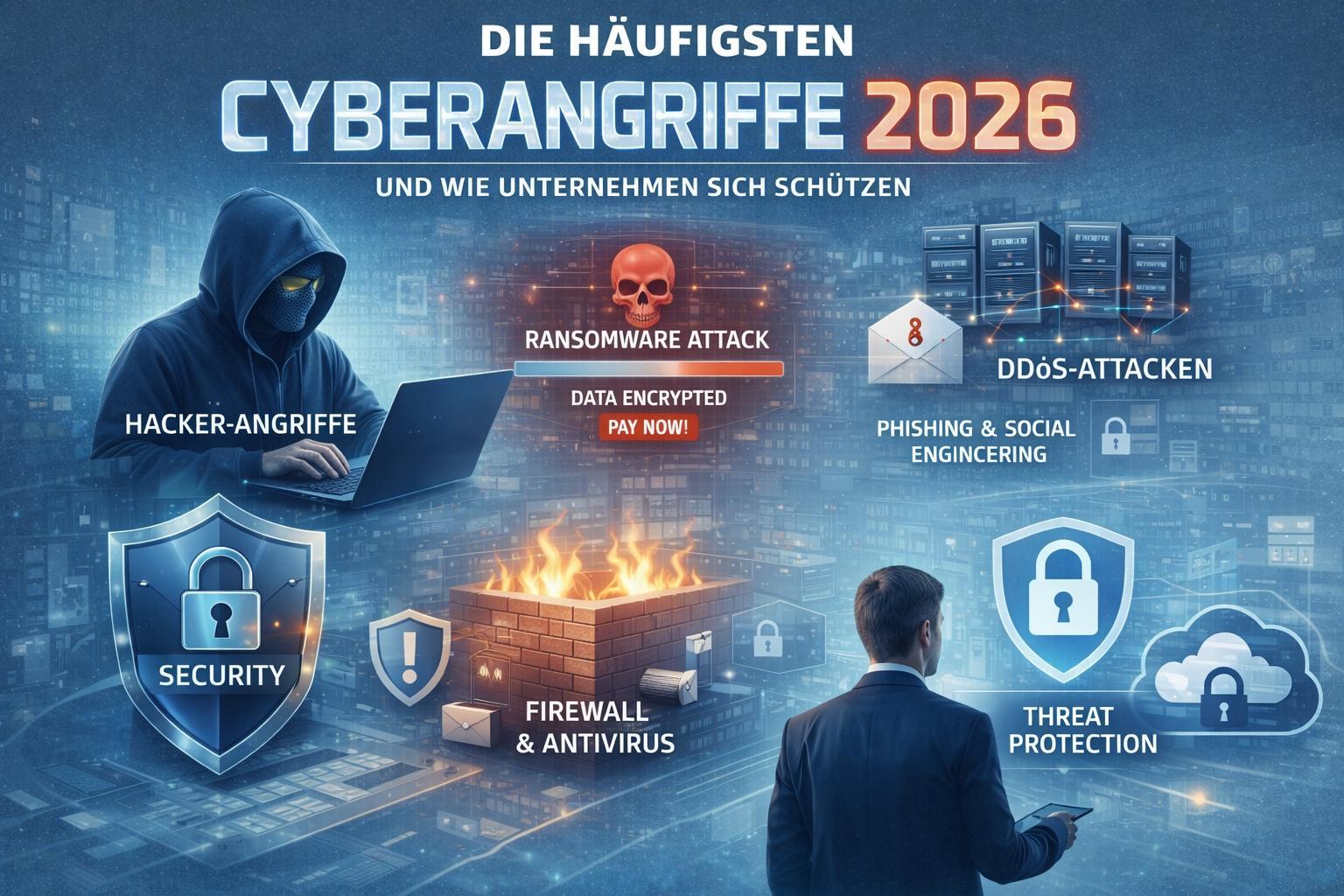
The IT security threat landscape has worsened dramatically in 2026. Organisations are facing a growing number of sophisticated cyberattacks. Modern attacks combine technology, artificial intelligence, Social Engineering and automated tools to compromise data, cripple systems or target supply chains. This article categorises the most important types of attack and provides technical recommendations for recommended actions.
Phishing and Social Engineering remain the number one attack vector
Phishing remains the main vector for cyberattacks: 68 per cent of all incidents begin with a deceptively genuine email or message, often generated by AI. Typical technical patterns include Spear-Phishing with targeted emails based on personal data, AI-generated texts that mimic the writing style of internal employees, multi-channel attacks via email (SMTP spoofing), SMS (smishing) and voice Phishing (vishing), as well as Malware links or files embedded in Office documents via Zero-Day exploits.
Effective countermeasures: implement SPF, DKIM and DMARC for all domains, conduct Security Awareness training with simulated Phishing attacks, make multi-factor authentication (MFA) mandatory for critical systems, and deploy AI-assisted email filters such as Microsoft Defender for Office 365 or Proofpoint.
Ransomware and double extortion as the greatest risk
Ransomware will be the greatest risk to critical infrastructure and SMEs in 2026. Attackers encrypt data and additionally threaten to publish it (‘double extortion’), which poses an equal threat to the reputation and finances of the affected organisations. Ransomware-as-a-Service (RaaS) now enables even groups without in-depth technical expertise to launch complex attacks. Attacks are often carried out via Remote Desktop Protocol (RDP), Phishing or exploit kits; modern variants also utilise fileless Malware, which operates directly in RAM.
-
Segmentation: Segmented networks and zero-trust architectures limit the spread of an attack.
-
EDR systems: Solutions such as CrowdStrike or SentinelOne enable behavioural analysis on endpoints.
-
Offline backups: Implementation of the 3-2-1 rule with regular recovery tests.
-
Patch management: Implement consistently for operating systems, Office applications and network devices.
AI-assisted attacks, supply chain and Cloud risks
Three further categories of attack are increasingly shaping the threat landscape in 2026:
AI-assisted attacks
Automated reconnaissance (port scanning, vulnerability scanning), mass personalised Phishing emails and deepfake calls for CEO fraud or Business Email Compromise (BEC).
Supply-chain attacks
Manipulation of software updates (see: SolarWinds), Malware in Cloud integrations or third-party APIs, and exfiltration via shared network access or SFTP/FTP servers.
Cloud misconfigurations
Exposed APIs, inadequate permission management and misconfigurations significantly expand the attack surface as Cloud usage increases.
Behavioural anomaly detection in email and network traffic, AI-based threat detection tools such as Darktrace or Vectra, and strong identity and access controls (IAM, SSO, MFA) help to counter AI-assisted attacks. When it comes to supply chain risks, risk assessments prior to onboarding third-party providers, segmentation of partner access and regular penetration tests – including third-party components – are crucial. Cloud risks can be significantly reduced through automated Cloud Security Posture Management (CSPM, e.g. Prisma Cloud or Check Point CloudGuard), consistent application of the least privilege principle, regular audits of storage buckets, databases and serverless functions, as well as API security gateways.
Cyber resilience: detect, respond, recovery
Prevention alone will no longer suffice in 2026. Organisations must build resilience to detect and isolate attacks and quickly achieve recovery of business processes.
-
Incident Response plans: With clear roles and defined communication channels.
-
Real-time Monitoring: Of networks, endpoints and Cloud services.
-
Automated recovery: As well as regular simulations of realistic attack scenarios.
Mint Secure GmbH
How Mint Secure supports you
We help organisations build long-term resilience against the current threat landscape.
penetration test
We test your systems, applications and processes from an attacker’s perspective, including Phishing simulations and Cloud configurations.
Security Audit
We assess your defences against Ransomware, supply chain risks and cloud misconfigurations.
Incident Response
We help you develop Incident Response plans and support you in responding to security incidents should they occur.
Ready to get started? We offer a free initial consultation. Get in touch.
Conclusion
The threat landscape in 2026 will be characterised by Phishing, Ransomware with double extortion, AI-assisted attacks, supply chain risks and cloud misconfigurations. Attacks are becoming increasingly automated and professional. Companies that rely solely on prevention will fall short in 2026; the key lies in building genuine cyber resilience through detection, response and rapid recovery.
Mint Secure provides consulting and supports you in strengthening your cybersecurity holistically. Talk to us.