The Zero Trust approach represents a fundamental shift in security strategy, based on the principle: ‘Trust no one, verify everything’. In this blog post, we explain what Zero Trust means, the principles behind it and how organisations can successfully implement this approach.
What is Zero Trust?
Zero Trust is a security concept based on the assumption that no user, device or network is inherently trustworthy. Instead, every access attempt is continuously verified and authenticated, regardless of whether it originates from within or outside the corporate network.
Traditional security models vs. Zero Trust: Whilst conventional security models are based on the ‘castle and moat’ principle – i.e. the assumption that internal networks are secure – Zero Trust assumes that threats can originate from both outside and inside the organisation.
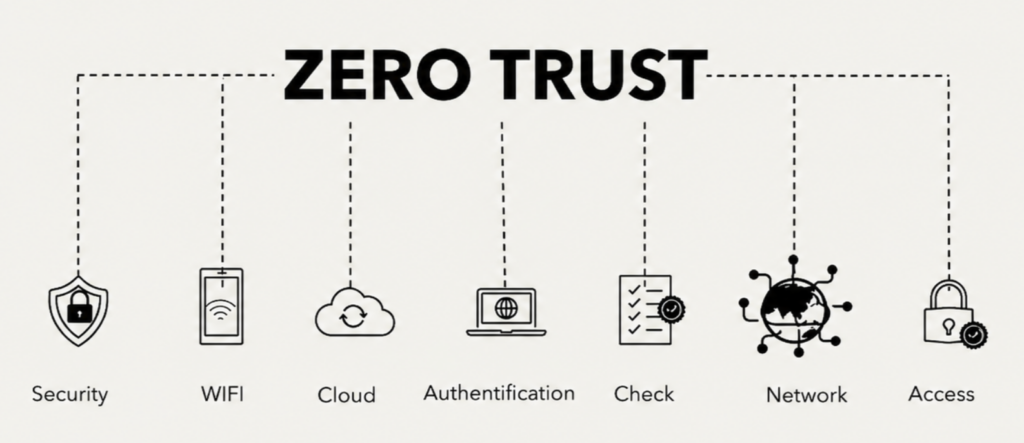
The fundamental principles of Zero Trust
Zero Trust is based on several key principles:
Distrust everything
Every access attempt is treated as a potential threat.
Least privilege principle
Users and devices are granted only the minimum necessary access rights.
Continuous verification
Identities and devices are continuously monitored.
Micro-segmentation
Networks are divided into small, isolated segments to minimise the attack surface.
Strict authentication
Every access attempt requires multi-factor authentication.
Implementation of Zero Trust in organisations
Implementing a Zero Trust model requires a combination of technologies, processes and training:
Identity and Access Management (IAM)
Strong authentication mechanisms such as multi-factor authentication (MFA) are essential.
Microsegmentation
Networks are divided into smaller, mutually isolated segments.
Threat and anomaly detection
Continuous monitoring of network traffic to detect unusual behaviour.
Zero Trust Network Access (ZTNA)
Granular access controls for users and devices.
Benefits and Challenges
Benefits: Improved security through continuous verification, a reduced attack surface through micro-segmentation, and protection against insider threats.
Challenges: The significant effort required for implementation, the need for comprehensive employee training, and interoperability issues between different systems and organisations should be taken into account when introducing Zero Trust.
Mint Secure GmbH
How Mint Secure supports you
The journey to Zero Trust is a process; we support you from the initial assessment right through to technical implementation.
Identity & Access Management
Design and implementation of IAM and MFA strategies as the foundation for Zero Trust.
Penetration testing
Checking whether micro-segmentation and access controls are actually effective in practice.
Security Consultancy
A bespoke roadmap for the phased introduction of Zero Trust within your organisation.
Would you like to find out more about specific implementation strategies? Then please feel free to get in touch. Contact us now.
Conclusion
The Zero Trust approach is an essential strategy for modern IT security. Organisations that implement Zero Trust can significantly improve their security posture and better protect themselves against cyber threats.
However, implementation requires careful planning and investment in technology and training; a one-off project is not sufficient.
Are you looking to introduce Zero Trust in your organisation? Get in touch with us.