
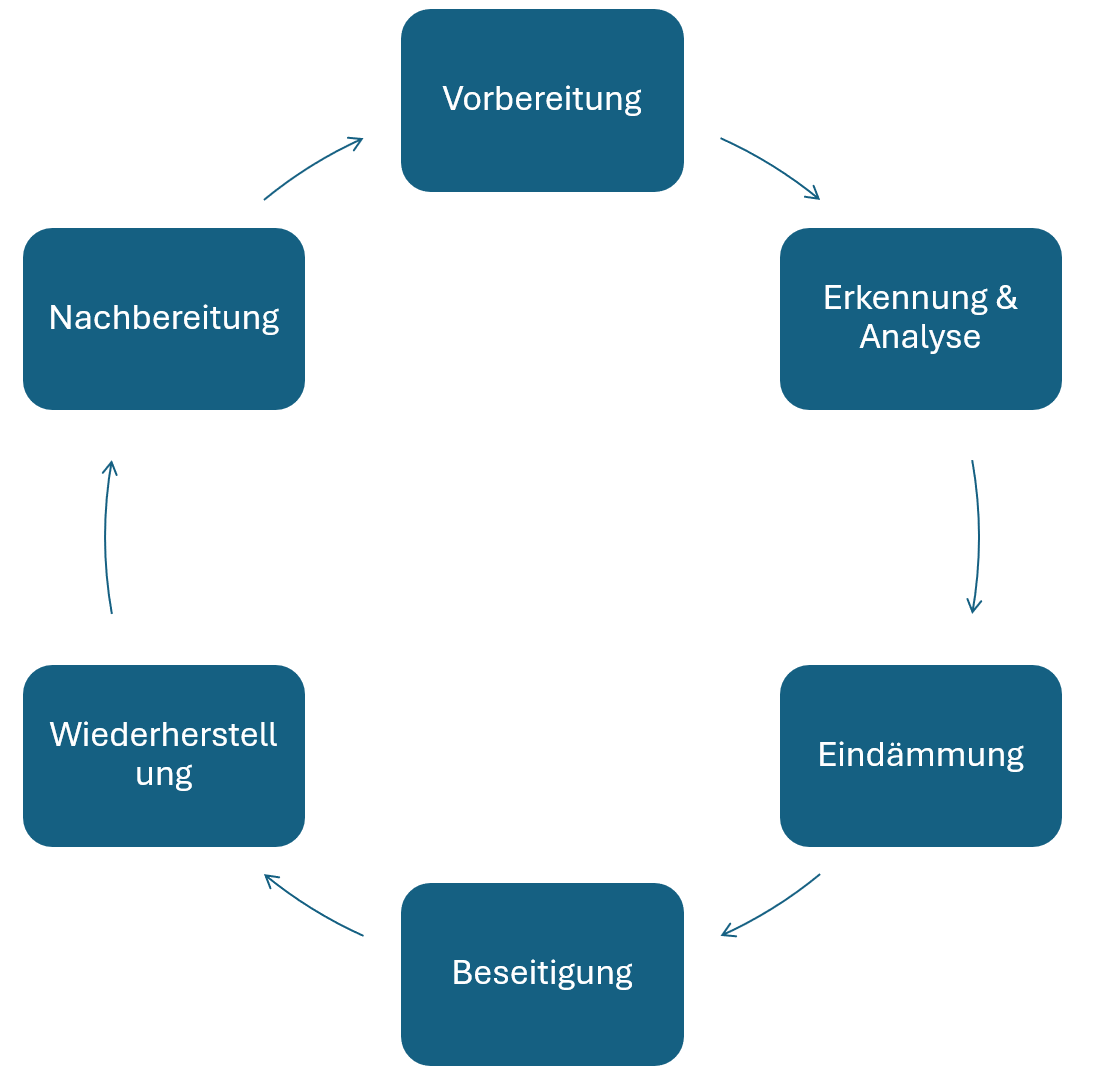
In today’s digital world, it is no longer a question of whether a security incident will occur, but when. Cyberattacks, data breaches or Ransomware attacks can affect any organisation, regardless of size or sector. To ensure a rapid, coordinated and effective response in the event of an incident, the National Institute of Standards and Technology (NIST) makes the following recommendation: a structured, six-phase approach: the so-called NIST Incident Response Lifecycle Model. In this article, you’ll find out what each phase involves, which measures are important and how you can best prepare your organisation for such an event.
1. Preparation
Preparation is the most important phase, as this is where the foundations for a successful Incident Response are laid.
-
Objectives: Setting up an Incident Response Team (IRT), establishing directives, roles and communication channels, training employees through awareness programmes, and implementing technical tools such as SIEM, IDS/IPS or endpoint detection.
-
Practical example: A company sets up a central Security Operations Centre (SOC), defines reporting procedures and ensures that backups are tested regularly.
2. Detection and Analysis
This phase involves detecting, validating and assessing security incidents.
-
Measures: Monitoring logs, network traffic and system activities; identifying suspicious events, for example through alarm notifications; and classifying them according to severity and type, such as Malware, Phishing or data exfiltration.
-
Practical example: Using a SIEM system, the SOC detects unusual login attempts from a foreign country and begins analysing the affected accounts.
3. Containment
The aim of containment is to stop the incident from spreading in order to prevent further damage.
-
Short-term measures: Isolating affected systems, blocking compromised user accounts and deactivating suspicious network connections.
-
Long-term measures: Setting up secure environments for analysis and preparing for recovery.
-
Practical example: An infected server is disconnected from the network whilst data related to forensics is backed up.
4. Eradication
Once the incident has been contained, all traces of the attack must be completely removed.
-
Measures: Removal of Malware, backdoors or malicious accounts; patching of security vulnerabilities; and update and hardening of systems.
-
Practical example: A compromised web system is cleaned up, passwords are reset and software vulnerabilities are patched.
5. Recovery
In this phase, systems are gradually returned to normal operation in a controlled manner.
-
Measures: Recovery from clean backups, monitoring systems for any further anomalies, and communicating with stakeholders and, where necessary, public authorities.
-
Practical example: Following a Ransomware attack, servers are recovered from verified backups and closely monitored.
6. Follow-up (Lessons Learnt)
Once the incident is resolved, the work is not yet complete. The next steps involve analysis and optimisation.
-
Objectives: Documentation of the incident and the measures taken, evaluation of the effectiveness of the response, and identification of improvements for processes and systems.
-
Practical example: The company produces an incident report, updates its security policies and adapts its alerting processes.
The six phases of the NIST framework provide clear, practical guidance for systematically managing security incidents. Organisations that implement this model and practise it regularly reduce downtime, minimise damage and strengthen their cyber resilience.
Mint Secure GmbH
How Mint Secure supports you
We support organisations through all six phases of the NIST model, from preparation to follow-up.
Incident Response
We provide support in detecting, containing and resolving acute security incidents.
IR Planning & Tabletop Exercises
We work with you to develop directives and communication channels, and train your team for an emergency.
forensics
We analyse incidents in detail and use the findings to identify improvements for your security architecture.
Conclusion
The six phases of the NIST Incident Response Lifecycle provide organisations with a clear, tried-and-tested guide for dealing with emergencies.
Organisations that understand these phases, practise them and integrate them into their processes can reduce downtime, minimise damage and significantly strengthen their cyber resilience.
Mint Secure supports you in setting up, training for and implementing your Incident Response process. Talk to us.