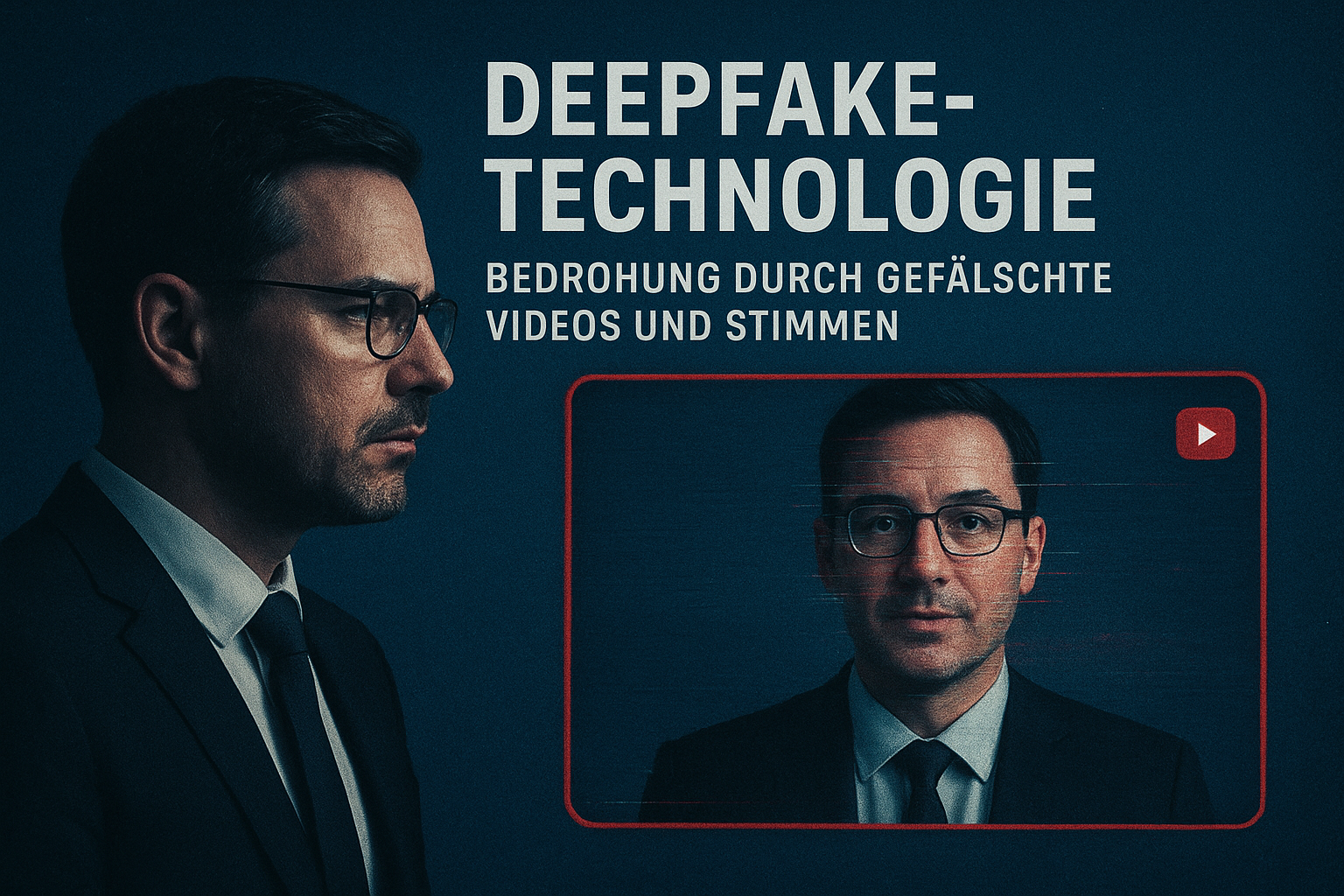
In the digital age, so-called deepfake technologies are advancing rapidly: With the help of artificial intelligence (AI), voices can be imitated, faces superimposed onto other bodies or entire videos manipulated – and so convincingly that real people are almost indistinguishable from their fake representations. What might seem like something out of a futuristic science-fiction film is already a reality today and poses major risks for companies, institutions and private individuals.
What are deepfakes?
Deepfakes use machine learning techniques, particularly Generative Adversarial Networks (GANs), to generate or alter image, audio or video content in such a way that it appears deceptively real. Two neural networks compete against each other: one generates the fake, whilst the other attempts to expose it. Through this competition, the results become more convincing with every training round.
Why is this dangerous?
The threat posed by deepfakes manifests itself in several ways, ranging from damage to reputation to tangible security risks.
Loss of trust and reputational damage
Even if it is a fake, a deepfake video purporting to show a company executive in a compromising situation can be damaging to their reputation and have serious consequences for the organisation.
Phishing, social manipulation and deception
Voices from fake sources can be used to impersonate a line manager who, via telephone or video call, orders a financial transaction. Employees believe the request and transfer money. Such scenarios have already been observed.
Misleading information and influence
Deepfakes can be used in public communications, on social media or through targeted attacks to spread disinformation, influence elections or deliberately cause confusion.
Security risks for businesses
Businesses that rely on integrity and confidentiality – such as financial institutions, the healthcare sector or critical infrastructure – are particularly vulnerable. A fake video or audio clip can facilitate access to systems or undermine trust.
How can deepfakes be detected and prevented?
- Raising awareness: Employee training is essential, for example for awareness raising about unusual communication patterns – such as a manager calling in person and immediately demanding a bank transfer – or visual inconsistencies in videos.
- Technical safeguards: Use of authentication methods such as multi-factor verification, secure communication channels and monitoring for unusual activity.
- Implement verification processes: Any critical instruction, particularly via audio or video, should be confirmed through alternative channels, such as by email followed by a return call.
- Use detection technologies: Tools exist that can detect fake media. However, AI technology is evolving at a similar pace, creating a constant race.
- Preparing for crises: Organisations should have an Incident Response plan in place that covers the scenario of fake media, including immediate external communication, internal alerting and legal assessment.
Why act now?
The fact that deepfake technology is available via easily accessible tools, combined with increasing computing power and user-friendly interfaces, means the threshold for such attacks is low.
Companies that fail to take action now expose themselves not only to the risk of financial loss but also to the risk of their reputation suffering significantly.
Mint Secure GmbH
How Mint Secure supports you
We help companies protect themselves against deepfake-based attacks and Social Engineering.
Security Awareness Training
We train your employees to recognise deepfakes, fake calls and manipulated videos.
Social Engineering Assessment
We simulate realistic fraud scenarios to uncover vulnerabilities in your processes.
Incident Response Consulting
We help you develop a robust incident response plan for fake media and fraud attempts.
Conclusion
Deepfake technology is no longer a vision of the future, but a real and growing threat to businesses, institutions and private individuals.
Anyone without verification processes and an incident response plan for fake media is ill-prepared for the next convincing phone call.
Mint Secure supports you in raising awareness amongst your employees and securing your processes against deception. Talk to us.