Daylight saving time and its impact on the IT world: more than just a lost hour
Every year, the clock change sparks debate, amongst private individuals as well as in businesses. Yet whilst many are primarily concerned about losing an hour’s sleep or disrupted routines, the clock change also has far-reaching implications for the IT world. This topic is particularly relevant to us, as even the smallest time discrepancies can have major technical and security-related consequences.
Looking ahead to the next clock change
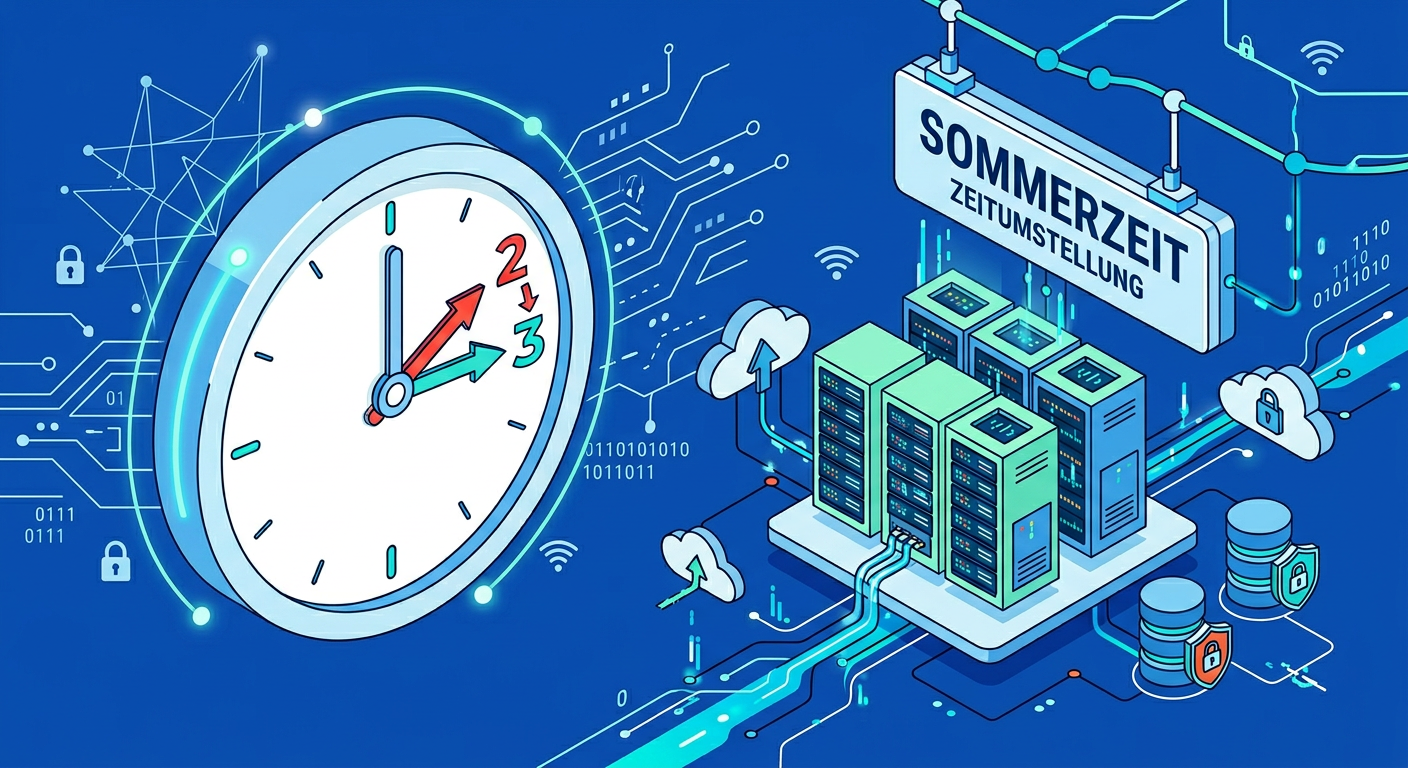
The next clock change in Germany will take place on 30 March 2026. During the night from Saturday to Sunday, the clocks will be put forward from 02:00 to 03:00, marking the start of summer time.
This particular time is critical for IT departments, as many systems run automated processes or carry out maintenance work precisely during this time window.
Why time plays a central role in IT
In the digital world, time is far more than just an organisational tool. Systems, networks and applications are highly synchronised. Timestamps are essential for:
- log files and Monitoring
- Authentication processes
- Database transactions
- Automated processes and cron jobs
A deviation of just a few seconds can already lead to inconsistencies; a whole hour, as is the case with the clock change, therefore presents a particular challenge.
Technical implications of the clock change
1. Time synchronisation issues
Many systems rely on so-called NTP (Network Time Protocol) servers to keep their internal clocks accurate. During the time change, short-term synchronisation problems may occur, particularly if:
- systems are not configured correctly
- Out-of-date time zone information is used
- Isolated networks do not have access to up-to-date time servers
2. Errors in scheduled tasks
Scheduled tasks (e.g. backups or updates) may, as a result of the time change:
- Be run twice
- Be skipped entirely
- Run at unexpected times
This particularly affects critical processes in production environments.
3. Inconsistent data
Time-based databases or logs may become inconsistent as a result of the switchover. For example, one event may appear to have taken place ‘before’ another, even though it actually happened later.
Security-related aspects
1. Manipulation of log data
Timestamps are a key component of IT forensics. If logs become jumbled as a result of the time change, this can:
- Make the analysis of security incidents more difficult
- Help attackers cover their tracks
- Encourage incorrect conclusions
2. Problems with authentication systems
Many security mechanisms are time-based, for example:
- One-time passwords (OTP)
- Kerberos tickets
- Certificate validation
If systems are not synchronised, legitimate access attempts may fail or, in the worst case, security vulnerabilities may arise.
3. Potential for attacks due to misconfigurations
Attackers deliberately exploit windows of opportunity when systems are unstable or incorrectly configured. The clock change can be one such moment, particularly if:
- Monitoring systems react incorrectly
- Alarms are not triggered correctly
- Security policies are time-dependent
Mint Secure GmbH
Best practices for businesses
Ensure automated time synchronisation
All systems should be reliably synchronised with trusted NTP servers.
Keep systems and software up to date
Time zone updates are part of many software updates and should not be overlooked.
Adjust Monitoring
Monitoring systems should be monitored more closely, particularly during the time change.
Ensure consistent logging
Using UTC (Coordinated Universal Time) can help to avoid inconsistencies.
Carry out tests before the changeover
Critical systems, in particular, should be reviewed in advance.
Check the backup schedule
Check whether backups are scheduled to start exactly during the time change, and if so, reschedule them to start after the time change.
How Mint Secure supports you
We help you set up your systems in a robust and traceable manner ahead of critical time windows such as the time change.
Technical Security Services
We check your NTP configuration, cron jobs and scheduled tasks ahead of critical time windows such as the clock change.
Security Consulting
We support you in setting up a consistent logging and Monitoring strategy, for example based on UTC.
Incident Response
If time discrepancies lead to anomalies in logs or authentication systems, we’ll help with the analysis.
We’ll review your critical processes together with you. Get in touch.
Conclusion
The time change may seem trivial at first glance, but in IT it can have significant implications, both technically and in terms of security.
With the upcoming change on 30 March 2026 in mind, organisations should be prepared and test their systems in good time. Those who understand and prepare their systems can not only minimise the risks of the time change, but also use it as an opportunity to make their own IT infrastructure more robust and secure.
Mint Secure can help you prepare your systems in good time. Talk to us.