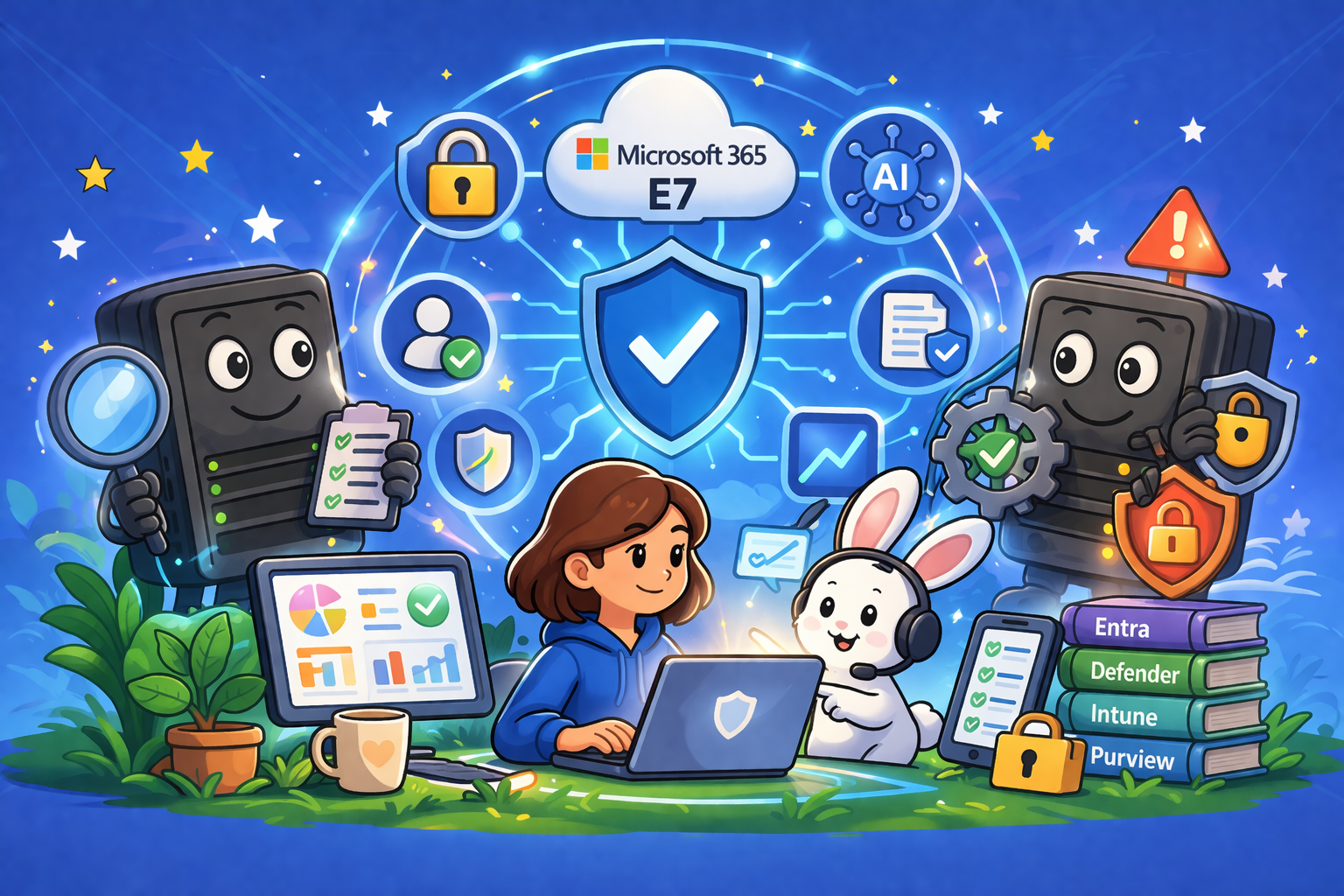
What does Microsoft’s new E7 licence mean from a security perspective?
Microsoft is launching a new suite, Microsoft 365 E7, on 1 May 2026. At first glance, this appears to be the next licence tier: E5, Copilot and Agent 365 bundled together for US$99 per user per month. But on closer inspection, it quickly becomes clear that this is not just another SKU, but a structural change in which security plays a central role.
Many IT organisations are familiar with the evolving architecture surrounding Microsoft 365: individual features, additional add-ons and the security and compliance modules built upon them. Over time, this results in a landscape that is difficult to maintain an overview of and even harder to manage consistently. This is precisely where E7 comes in. Microsoft is bundling productivity, AI, identity and governance into a single integrated platform. The aim is no longer just functionality, but controllability.
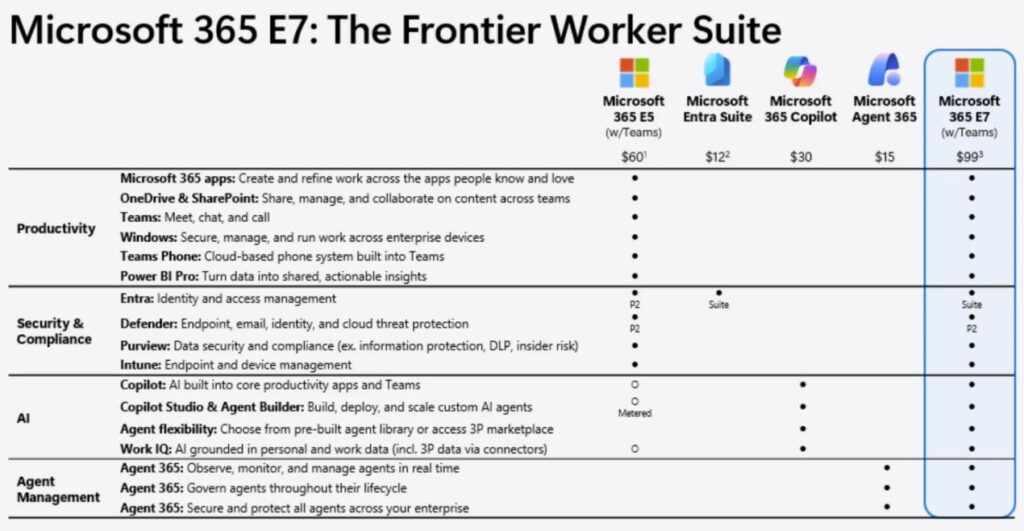
Whilst much of the current discussion centres on Copilot, the real change lies elsewhere: with agents. These go far beyond traditional assistant functions. They actively access corporate data, carry out tasks independently and interact with systems and processes. This makes them an operational part of the IT landscape, and that is precisely what makes them so relevant from a security perspective.
As soon as agents have access to mailboxes, files, chats or business processes, the risk profile changes fundamentally. It is then no longer just a matter of user rights in the traditional sense, but of machine identities, automated decisions and scaled access to sensitive data. Issues such as least privilege, clear role models and full traceability are no longer optional, but absolutely essential. At the same time, a new attack surface is emerging, one that many organisations currently still underestimate.
Agents take centre stage; governance becomes crucial
With Agent 365, Microsoft is seeking to address precisely this challenge by creating a central control layer for agents. This is intended to ensure transparency, enforce directives and make usage manageable. Without such a mechanism, there is a real risk of a proliferation of agents operating outside clear governance frameworks, accessing data and influencing processes without IT and security teams being able to maintain an Overview.
In our view, this is one of the most critical aspects of the current development.
At first glance, the price of US$99 per user seems high. At the same time, this view is too narrow. What matters is not what E7 costs, but what it costs to operate this new reality without integrated security and governance. Organisations are increasingly faced with a choice between a fragmented ‘best-of-breed’ approach involving many individual solutions and a highly integrated platform strategy. For security teams, this means less tool sprawl, but also greater reliance on a centralised architecture.
Timing is key: those who adopt E7 too early, without clean data structures, robust role models and established governance, run the risk of exacerbating existing weaknesses through AI and automation. Conversely, those who wait too long risk business departments developing their own solutions and agents, leading to shadow IT and security losing control. In both cases, risks arise that can only be rectified later at great expense.
Not a traditional licensing decision
From a security perspective, E7 is therefore less a licensing issue than a clear impetus to tackle fundamental groundwork. Identities must be rethought, because it is no longer just people but also agents who have access to systems. Data must be properly classified and access consistently restricted, because AI highlights precisely those gaps that were previously tolerated. And security must no longer be viewed as an afterthought, but must be an integral part of every AI initiative.
With E7, Microsoft makes it clear that the digital workplace of the future is no longer built exclusively for people. Agents are becoming an integral part of processes and decision-making. This also shifts the role of security. It is no longer merely a protective mechanism, but becomes a control layer for trust, control and scalability.
Mint Secure GmbH
Further information from Microsoft: Introducing Microsoft 365 E7
How Mint Secure supports you
Whether it’s identity models, data classification or governance for agents: we help you lay the foundations before you adopt E7 or similar integrated platforms.
Security consulting
We guide you through identity, role and governance concepts for both people and agents.
Technical Security Services
Technical assessment of your Microsoft 365 environment with regard to data classification, access models and configuration.
AD Security Audit
We assess how robust your identity infrastructure is against new machine identities and agent access.
Are you planning to migrate to E7? We’ll work with you to assess your current situation. Get in touch.
Conclusion
E7 is not just another licence upgrade, but a wake-up call for identity, data classification and governance.
As soon as agents independently access corporate data and carry out tasks, security shifts from being a downstream control mechanism to a control layer for trust and scalability.
Mint Secure helps you lay the foundations for the secure deployment of E7 and Agent 365. Talk to us.