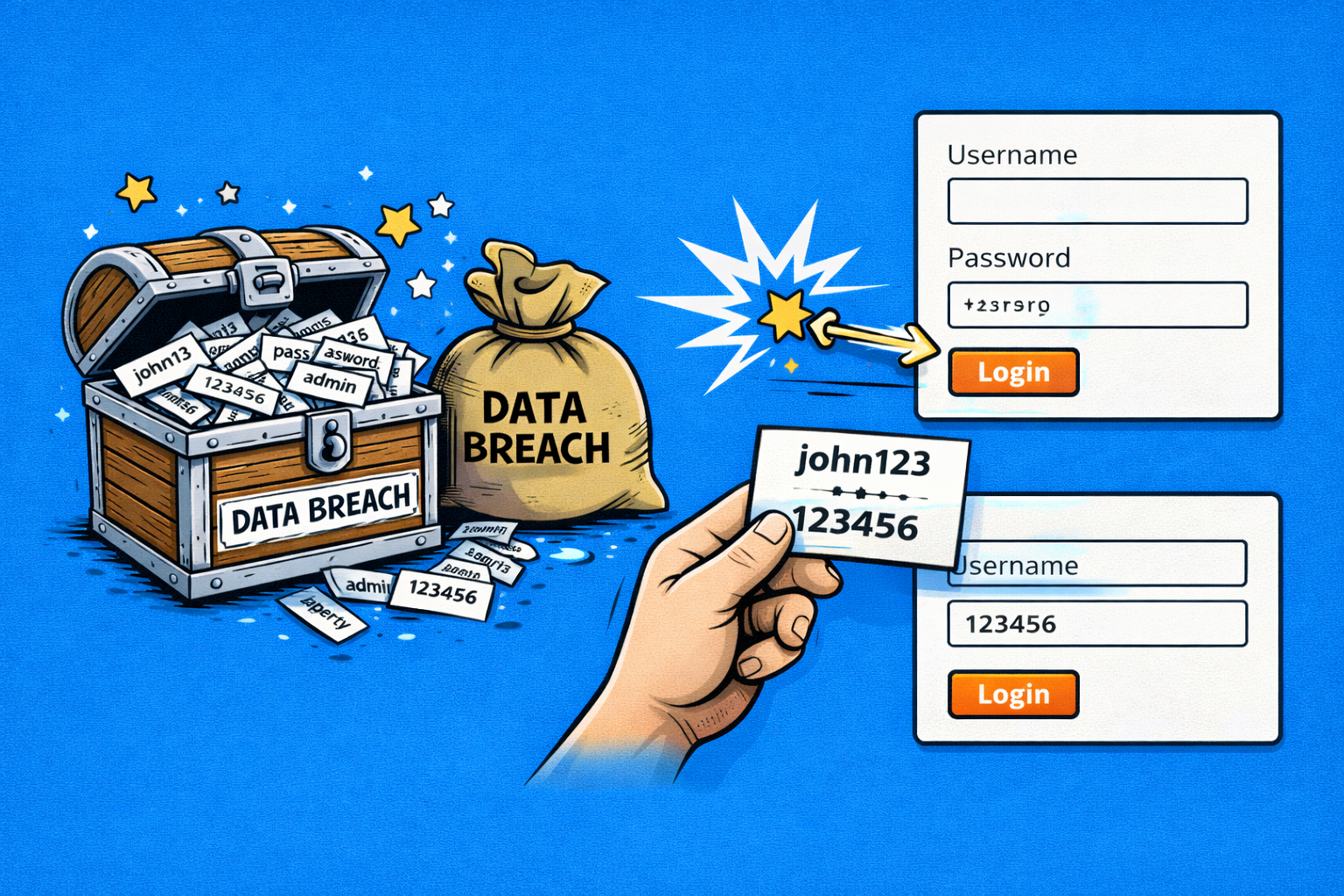
Credential stuffing is now one of the most common and, at the same time, most successful attack techniques used against web applications. The approach is technically straightforward, but the consequences are often significant, from the perspectives of security, compliance and reputation alike.
This article examines credential stuffing from a technical perspective, highlights typical attack patterns and outlines practical countermeasures.
What is credential stuffing?
Credential stuffing refers to automated login attempts using username/password combinations that have already been compromised. These credentials usually originate from previous data breaches (e.g. forums, online shops, SaaS platforms) and are systematically tested against other services.
The attack is based on a simple but empirically proven assumption: users reuse passwords.
Unlike brute-force attacks, this method does not rely on guesswork but uses validated data. As a result, the login attempts are significantly more efficient and harder to distinguish from legitimate access attempts.
Typical sequence of an attack
Acquisition of credentials
Leaks from previous breaches, credential dumps or underground marketplaces.
Processing
Normalisation of formats (email/username, password), deduplication, validation.
Automated login attempts
Use of specialised tools or botnets, often involving:
- Rotating IP addresses
- Realistic user agents
- Customised timing
Account takeover (ATO)
Successful logins are exploited further (e.g. resale, fraud, data exfiltration).
Why traditional security measures are often insufficient
Many applications continue to rely on simple mechanisms such as:
-
Static rate limiting
-
IP-based blocklists
-
CAPTCHA after X failed attempts
These approaches are only of limited use against credential stuffing, as attackers:
-
Spread their login attempts widely
-
Generate low error rates per IP address
-
Use valid credentials
From the application’s perspective, the traffic often appears ‘normal’.
Technical and organisational risks
A successful credential stuffing attack can lead, amongst other things, to the following problems:
-
Account takeovers with consequential damage (fraud, identity theft)
-
Data protection incidents under the GDPR
-
Loss of customer trust
-
Secondary attacks (e.g. privilege escalation within the platform)
It is not without reason that credential stuffing regularly features among the top risks identified by OWASP and other security organisations.
Effective countermeasures (defence in depth)
A single protective mechanism is generally not sufficient. A multi-layered strategy has proven effective:
Strong authentication
- Multi-factor authentication (MFA) as standard
- Adaptive MFA based on risk (IP, device, behaviour)
Anomaly and Behavioural Analysis
- Detection of unusual login patterns
- Correlation across users, IP addresses and time windows
Credential Hygiene
- Assessment of new passwords against known data breach databases
- Enforcing unique passwords
Bot mitigation
- Headless browser detection
- Fingerprinting (client- and server-side)
- Dynamic challenges instead of static CAPTCHAs
Monitoring and Incident Response
- Explicit alerts for login anomalies
- Pre-prepared ATO playbooks (account lockout, reset, user information)
Mint Secure GmbH
How Mint Secure supports you
Organisations should not view credential stuffing as merely an authentication problem, but as a systemic risk that requires architectural, Monitoring and awareness measures.
Penetration Testing
We assess just how resilient your login mechanisms really are against automated attacks such as credential stuffing.
Security Consulting
We provide support with the implementation of MFA, credential hygiene and the development of a defence-in-depth strategy.
Incident Response
In the event of a suspected breach, we assist with account suspension, analysis and structured user communication.
Do you know how resilient your login page is? We’ll assess it together with you. Get in touch.
Conclusion
Credential stuffing is not some exotic, specialised attack, but a standard tool used on a massive scale. The technical effort required by attackers is minimal, whilst the potential impact on organisations is significant.
Organisations should therefore not view credential stuffing as merely an authentication problem, but as a systemic risk requiring architectural, Monitoring and awareness measures. Anyone who takes login security seriously cannot do without MFA, intelligent detection and proper incident handling.
Mint Secure can help you bring all these elements together. Talk to us.