Active Directory (AD) has been at the heart of most corporate networks for over two decades. It manages users, computers, group policies, servers and permissions. In short: it is the control centre of every IT infrastructure. This is precisely why it is also the primary target for cybercriminals.
Yet whilst organisations invest in modern security solutions, AD often remains one of the least secure systems of all. Why is this the case? And why do attacks – ranging from Ransomware to targeted APT campaigns – almost always start right here?
This article examines the reasons behind this, typical vulnerabilities and what organisations can do in practical terms to reduce such risks in the long term.
Why attackers love Active Directory
Access to Active Directory means control over the entire organisation
If an attacker has domain administrator rights, they can do practically anything:
- Take over user accounts
- Encrypt systems
- Exfiltrate data
- Disable security solutions
- Cover their tracks
Active Directory is a single point of failure and therefore a prime target for any group of attackers.
AD environments are often outdated

Many Active Directory installations date back to a time when cyberattacks were on a different scale. Typical examples include:
- outdated GPOs that have never been deleted
- orphaned accounts belonging to former employees
- over-privileged service accounts
- missing tiering models
- unclear responsibilities
With every year of technical debt, the attack surface grows.
Attackers know AD misconfigurations inside out
Whilst administrators have to tackle new challenges on a daily basis, attackers use specialised tools to specifically exploit vulnerabilities in AD:
- BloodHound
- Mimikatz
- Kerberoasting tools
- Lapsus$-style credential dumping techniques
These tools make it extremely easy to detect critical misconfigurations, often within a matter of minutes.
The most common and dangerous AD vulnerabilities
Overprivileged user accounts
In almost every organisation, there are accounts that have significantly more rights than they need. Examples:
- Domain administrators whose passwords are never rotated
- Service accounts with domain admin rights
- ‘Security emergency accounts’ that nobody monitors
These accounts are a goldmine for attackers; often, compromised credentials alone are enough.
Missing or weak password standards
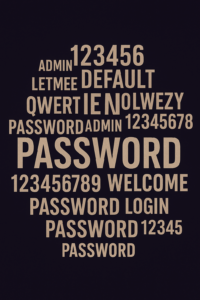
A single password such as ‘Winter2024!’
can be enough to move laterally across the network. Particularly critical:
- Passwords that have been leaked in hashed form
- Service accounts with static passwords
- Reuse of passwords across multiple systems
- Passwords that are vulnerable to known dictionary attacks
- Passwords that contain the company name
Password spraying and Kerberoasting are so successful because they exploit these weaknesses.
Outdated or incorrectly configured GPOs
Group Policy Objects are powerful and dangerous when used incorrectly:
- Write permissions for non-admins
- Outdated policies that create security vulnerabilities
- logical errors in the linking
An attacker who manipulates a GPO could potentially gain control of the entire network.
Gaps in network segmentation
Many organisations still have ‘flat networks’. This means:
- a compromised PC can reach as far as the domain controller
- servers are accessible without any barriers
- Workstations can communicate laterally
- Even photocopiers can be taken over, allowing access right up to the domain controller
Lateral Movement is then only a matter of time.
Outdated or insecure protocols
NTLM, SMBv1, lack of LDAP signing – all classic examples. Even in 2025, these protocols are still alarmingly common, despite making life easier for attackers. The problem with these protocols is that making a change or switching to secure protocols means administrators have to undertake a major project straight away, due to numerous dependencies on other systems within the IT infrastructure.
Mint Secure GmbH
How attackers typically proceed: a realistic attack scenario
- Initial access
: A compromised password, a Phishing email, an unsecured VPN connection – often, even a standard user is enough. - Reconnaissance in the AD
Tools such as BloodHound are used to analyse the AD structure. The result: an ‘attack graph’ showing how to become a domain administrator in just a few steps. - Lateral Movement
Attackers move undetected from system to system, e.g. via:- Pass-the-Hash
- Pass-the-Ticket
- Remote code execution via SMB
- Privilege Escalation
An over-privileged service account or a faulty GPO is all it takes. - Domain Takeover
From this point onwards, the attacker has full control and can exfiltrate data or deploy Ransomware.
What organisations can do: Why regular AD Pentests are crucial
One-off measures are not enough. AD is a living, breathing system that is constantly changing. That is why Pentests and audits are essential.
Recommended measures
AD penetration test
A realistic view from an attacker’s perspective, identification of privilege escalation paths and assessment of overall identity security.
AD hardening in line with best practice
Implementation of a tiering model, hardening of administrator accounts, hardening of protocols and Group Policy Objects (GPOs), and removal of over-privileged accounts.
Password Audit
Review for compromised or weak passwords, Dark Web checks and comparison against dictionary lists.
Continuous Monitoring & Review
Monitoring of critical AD events, regular privilege reviews and recertification of accounts and permissions.
Conclusion
Active Directory remains one of the most important points of attack and, at the same time, one of the most neglected areas of corporate security. Attackers often need only a single weak password, a misconfiguration or a forgotten service account to take control of the entire network.
A professional AD Pentest, combined with a structured Active Directory hardening programme, is no longer a luxury but a fundamental requirement for modern corporate security.
If you are interested in addressing the topics mentioned above, please take a look at our Microsoft Security Services:
And our X-MAS Special is particularly worthwhile for you right now.

How Mint Secure supports you
Whether it’s Pentests, hardening or Monitoring: we’ll work with you to secure your Active Directory against today’s attack techniques in the long term.
Active Directory pentesting
We identify privilege escalation paths and misconfigurations before attackers find them.
Microsoft M365 hardening
We harden your Microsoft 365 and hybrid AD environments in line with the latest best practices.
Password audit and monitoring
We check passwords for signs of compromise and set up continuous Monitoring of critical AD events.
Conclusion
A single weak password, a forgotten GPO or an over-privileged service account is often enough for attackers to gain full control of Active Directory and, consequently, the entire corporate network.
Regular AD Pentests and a structured hardening programme are no longer optional extras, but essential requirements for robust corporate security.
Mint Secure supports you in securing your Active Directory for the long term.
Talk to us.